

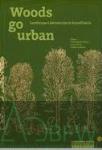
- TitelWoods go urban - Three Landscape Laboratories in Scandinavia
- Verfasser
- Auflage2. Aufl.
- ErscheinungsortStockholm
- Verlag
- Erscheinungsjahr2025
- Seiten383 S.
- MaterialMonographie
- ISBN978-94-92474-650
- Standardsignatur18663BU
- Datensatznummer40006046
- AbstractLet’s bring the woods into our cities. The planet is urbanizing. More than fifty percent of humanity lives in cities. Not all of those cities resemble the densely populated city centers of, for example, historic Paris or towering Manhattan. Most of our cities are made up of loosely built-up areas where urban and countryside meets in a mix of residential districts, shopping centers, residual nature, industrial areas, highways, agricultural lands, farms and villages. Urbanized territories need to be adjusted urgently We need to increase the vegetation cover in these highly populated regions to adapt them to climate change and to support a wider range of ecosystem services: the conservation of biodiversity and the development of recreational areas. Put simply, parks and other types of green spaces need to become more wooded and urban woods must become a new dominant category of public space in urbanizing regions. Cities of trees. People are naturally inclined to congregate in communities. So are trees. Most trees live together in forests, woodlands, or simply woods. They are the cities of trees, and we love them! We often say to one another, let’s go to the woods. But what if it was the other way around? If the woods came to us, into our cities? This reflection might seem obscure. At a second though however, it just might be the most logical and right thing to do. In academia, planning, policy, as well as in society at large, claims about the benefits of urban woods are multiplying.

- Schlagwörter
| Exemplarnummer | Signatur | Leihkategorie | Filiale | Leihstatus |
|---|---|---|---|---|
| 18663BU | 18663BU | Monographie | Institut für Waldbiodiversität und Naturschutz | Verfügbar |

Hierarchie-Browser